This is the report Barcelona Birding Point’s Ebro Basin in Winter Tour (2012 issue) which started in December, 10th and ended in December, 16th. During the tour we spot 158 species of birds despite two windy/rainy days.

Cetti’s Warbler (Cettia cetti) is a common bird along Catalan reedbeds and it is easier to spot during winter.
Day 1. Once we picked up all costumers from their hotels in Barcelona we start the birding week expecting to find most of the more delighted specialities of Mediterranean, high mountain & steppe areas. Our first spot was in Llobregat Delta, a small wetland only ten kilometres South of Barcelona. A short-walk allowed us to find some interesting birds. First we encountered two Common Waxbill (Estrilda astrild) small flocks. Common Waxbill is a small, funny bird living along small rivers and channels in Catalonian coastline. Despite its scaped conditionit, this African speciality have steadily increase its populations since XX 80’s. It was also interesting our first Sardinian Wabler (Sylvia melanocephala), a small warbler related to coastal garrigas but also to thickets, farm lands and even gardens. European Serin (Serinus serinus) was also singing on a dead tree. Despite it is a fairly common bird, Serin is mostly a coastal species during winter. Other interesting species appearing included Fieldfare (Turdus pilaris), a scarce winter visitor, especially along the coast; Peregrine Falcon (Falco peregrinus), Green Sandpiper (Tringa ochropus), the elusive Cetti’s Warbler (Cettia cetti), Tufted Duck (Aythya fuligula), Gadwall (Anas strepera) and Monk Parakeet (Psittacula krameri).
We then moved to Pyrenees, where we first stopped in some open fields looking for some birds flocking around farm lands. Here we discovered beautiful Rock & Cirl Buntings (Emberiza cia & Emberiza cirlus) moving with large amounts of Chaffinches (Fringilla coelebs), Goldfinches (Carduelis carduelis), Tree Sparrows (Passer montanus) and Stonechats (Saxicola rubetra). We moved then to the upper areas of Cadí-Moixeró Natural Park, where we expected to find some high mountain birds. A short walk allowed us to encounteer small groups of Chamoises (Rupicabra rupicabra) roasting on the alpine grasslands. These beautiful wild coat are one of the most common herbivorous in high mountain grasslands. Birds began to appear, first a small flock of three Alpine Accentor (Prunella collaris) moving on barren slopes, its favourite winter ground. At the same moment a gorgeous Lammergeier (Gypaetus barbatus) was appearing flying over us, its light orange body shinning and reflecting on the snowed slopes and its slow, low flight as a dance over the forest edge. We spend some more time walking around and those forest edges provided Coal, Long-tailed and Crested Tits, Treecreeper (Certhia familiaris), Mistle Thrush (Turdus viscivorus) and some gorgeous Griffon Vultures (Gyps fulvus). A latter riberine short-walk provided nice views of Siskin (Carduelis spinus), Brambling (Fringilla montifringilla) and more Rock Buntings as well as lovely a Dipper (Cinclus cinclus) with its characteristic “jump-dance” among the rocks of a high mountain stream.

Lammergeier (Gypaetos barbatus) adult is not any more an uncommon view in some Pyrenean valleys.
Day 2. An early start was required to explore the huge Boumort National Game Reserve. A small stop in the road reported some forest species and fastly arrived to the most productive points. We found our first crowd of Griffon Vultures flying around. The sunny (but cold) day was important to get nice views of those huge birds of prey. Before midday some massive Cinereous Vultures (Aegypius monachus) were appearing. A total of four of them were spotted along the day, including both juveniles (2) and adults (2). There are only about 30 of them in those massifs, being the only population on both Catalonia and the whole of the Pyrenees. Opositte to Griffon Vultures, Black Vultures use to move in pairs or small (4-5) flocks looking for small carrions. Lammergeier was also appearing. Once again we could enjoy the flight of the Eurasian most elegant vulture. A beautiful adult moving over Scots Pine forests and, later, two more (immatures). Other raptors flying over the wild valley included an adult Golden Eagle (Aquila chrysaetos) as well as Northern Goshawk (Accipiter gentilis).

Wallcreeper (Tichodroma muraria), one of the most strikking birds living in high mountains.
A lovely small walk leaded us to impressive cliffs that hosts numbers of nesting Griffon Vultures, Golden Eagles, Lammergeiers and, in summer, Egyptian Vulture. This location provided one of the prime targets and most delighted birds for European birders: Wallcreeper (Tichodroma muraria). Wallcreepers nest in inaccessible high mountain cliffs and ravines. In winter they come to lower altitudes searching for warmer areas. They are solitary birds due to the low productiveness of the habitat where they live. We counted to be lucky as we got a two-minutes-long-view of one of these incredible birds just at the moment of arriving to our view point in the cliffs. Other highlights of the cliffs included a male Hen Harrier (Circus cyaneus) our first record of Red-billed Chough (Pyrrhocorax pyrrhocorax), Rock Sparrow (Petronia petronia) as well as unforgettable sights of both Griffon Vulture and Lammergeier. Here was also the place to find Blue and Great Tits, Song Thrush (Turdus philomelos) and Short-toed Treecreeper (Certhia brachydactyla), a fairly common resident in all kinds of forests in Catalonia.
Day 3. Last day in the Pyrenees. From our hotel, and while having breakfast, we found Great Spotted Woodpecker (Dendrocopos major) and, few meters away, both Hawfinches (Coccothraustes coccothraustes) and Bullfinches (Pyrrhula pyrrhula) moving along a wooded stream. These species are somehow scarce and thus they are always appreciated by all birders. Our first stop that day was the cliffs and riberines North of Camarasa. Here we found the striking Blue Rock Thrush (Monticola solitarius) in the sedimentary cliffs. A pair moving around the cliff, being very active in with the midday sun. Some other specialities appearing here included Firecrest (Regulus ignicapillia), Dunnock (Prunella modularis), Siskin, Rock Bunting and a nice couple of Sardinian Warblers moving in the bushed cliffs. But before we spent some time in the firsts plains we encountered in our way. Even from the road we found an important amount of birds including our first Iberian Grey Shrike (Lanius meridionalis), Corn Bunting (Miliaria calandra) and a juvenile male of Yellowhammer (Emberiza citrinella), a scarce species only living in Northern Catalonia. A further short-walk reported us a glimpse onto a Red-legged Partridge (Alectorix rufa) flock.

Boumort is an unique view-point over the Pyrenees and its valleys.
After lunch we visited the huge Estany d’Ivars i Vila-Sana, a 60 hectarees wetland in the middle of the plains that reported our first beautiful Purple Swamphen (Porphyrio porphyrio) in the reeds, a nice pair of the recently split Iberian Green Woodpecker (Picus sharpei) along with Penduline Tit (Remiz pendulinus) –after an intense reseach-, White Stork (Ciconia ciconia), Reed Bunting (Emberiza schoneiclus), Great Egret (Egretta alba) as well as nice sights of Cattle Egrets (Bubulcus ibis) and a intense activity in the Marsh Harriers (Circus aeruginosus) roosting site.
Day 4. Time to explore to lonely plains of Los Monegros. This huge cereal-steppe provided some of the best birding moments in the tour. It was nine o’clock in the morning when we approach those immense fields and we surprisingly fast found our first flock of Great Bustards (Otis tarda). After several counts we finally decided that there were 23 individuals in the flock. Number of birds was highly important as this is a really endangered species in Los Monegros with about 30 individuals left. After enjoy long enough watching those giant birds peacefully eating on the fields we moved a bit to scan some fields around in order to locate some of the numerous larks living here. Along the next minutes we got nice views of Crested Lark (Galerida cristata), Calandra Lark (Melanocorypha calandra), Skylark and some minutes later the scarce Lesser Short-toed Lark (Calandrella rufescens), heavily linked to small spots of primary Thyme and steppe-like vegetation.
The morning was still going on when we found several flocks of birds roasting in a huge field. Apart from a large flock of finches (mainly Linnets –Carduelis cannabina– but also Goldfinches –Carduelis carduelis-) there were at least 52 Red-billed Choughs roasting along with Starlings (among them some Spotless Starlings –Sturnus unicolor-), Lapwings and Calandra Larks. We were just trying to find the Calandra Larks when a female Merlin (Falco columbarius) appeared attacking some of the birds… All birds on the field fastly flew off. It was the moment to find out a new field…
Some kilometers ahead we listened a pair of Black-bellied Sandgrouse (Pterocles orientalis) flying over the area. These birds can be extremely difficult to locate on the fields so we didn’t miss the chance to try an approach. The pair stopped some 1,5 kilometres from us so we didn’t lose time and drove as close as possible. Our determination gain for us a beautiful ten minutes long view of both male and female roasting on ground!!
Just a few minutes latter a big flock of over 30 Sandgrouses flew over us. There were both species Black-bellied and also the slighter Pin-tailed Sandgrouse (Pterocles alchata) flying East in an awesome chorus of calls. It was about midday and we began to go for lunch, a bit silent and sad because Little Bustard (Tetrax tetrax) was not appearing yet. But a last trial in some open fields of their liking produced a nice (although a bit far) sight of a flock of eight of them!! Little Bustard, as all steppe-living specialities, can be highly striking, but we got a not-so-bad sight of them.

Black-bellied Sandgrouses (Pterocles orientalis), a wonderful bird living in cereal-steppes, Los Monegros.
In the afternoon it was time to visit a lagoon close to Candasnos, which provided nice sights of several ducks (including Red-crested Pochard –Netta rufina– and Ferruginous Duck (2) –Aythya nyroca-) as well as Common Crane (Grus grus). Before in our way to the lagoon we found some beautiful Thekla Larks (Galerida theklae), maybe the most delighted Iberian lark (apart from Dupont’s) for most European birders.
Day 5. This day weather was not a good mate and from early morning we didn’t have good sensations about. We explored some steppe areas in Western Monegros. This spot is noted for several steppe-living specialities. We encountered here some specialities including Little Owl (Athene noctua), Iberian Grey Shrike (Lanius meridionalis), Red-legged Partridge (Alectoris rufa), Hoppoe (Upupa epops) and Dartford Warbler (Sylvia undata). Special mention to the beautiful and absolutely unexpected pair of Spectacled Warbler (Sylvia conspicillata) that we found in perfect summer plumage (male) and actively moving around. This warbler is supposed to be a summer speciality in both Aragón and Catalunya, leaving their nesting areas in early September!! There are some sedentary populations in South-east Spain but there are only three records for winter individuals in Catalonia (related to coastal areas) and no records have been found in Monegros in winter.
In the afternoon was the time to search for both Eurasian Eagle Owl (Bubo bubo) and Black Wheatear (Oenanthe leucura), two delighted specialities living in cliffs and barren slopes. Black Wheatear was appearing quite fast as they favours small rocky areas facing South as winter grounds. Eurasian Eagle Owl was more difficult but finally its impressive silouhette was emerging from the cliffs…
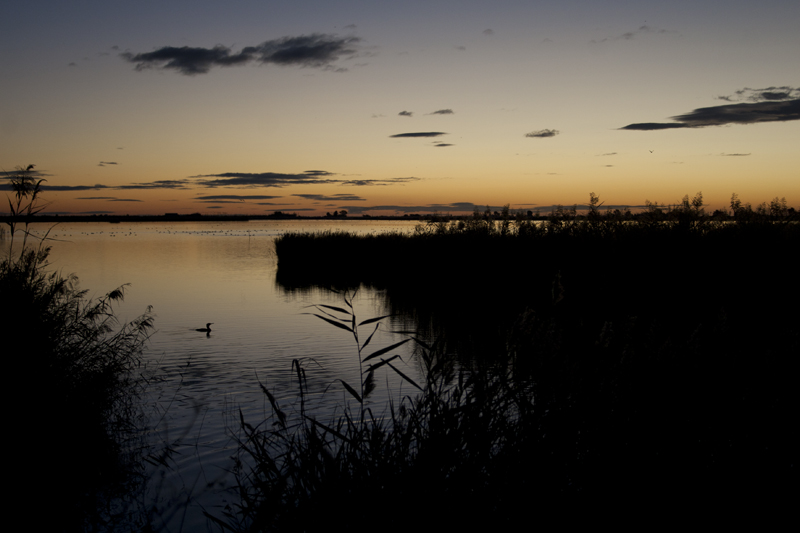
Amazing winter raising in l’Encanyissada, the main fresh water lagoon in Ebro Delta.
Day 6. Our first morning in Ebro Delta. This huge delta host troops of gulls, herons, ducks and seabirds. Almost the first bird we found in our way was an Audouin’s Gull (Larus audouinii), an elegant gull mostly wintering in South Spain with only a few winter birds in Ebro Delta (thought Ebro Delta concentrates over 65% of world’s population between February-March and September-October). After such a good start we stopped several times along the road to have views of some common birds in Ebro Delta including Great Egret and huge flocks of both Greater Flamingo (Phoenicopterus roseus) and Glossy Ibis (Plegadis falcinellus). We then decided to visit one of the main fresh water lagoons to search for more birds and that spot offered us nice views of Water Rail (Rallus aquaticus), Purple Swamphen (Porpyrhio porpyrhio) -+20-, Common Kingfisher (Alcedo atthis), Cetti’s Warbler (Cettia cetti) and Squacco Heron (Ardeola ralloides), another summer visitor that is becoming a normal winter bird last years. Number of ducks, grebes and Marsh Harriers were also appearing.
We continued the day visiting paddy fields around the lagoon that were full of Egrets and Herons, including a small flock of eight White Storks (Ciconia ciconia) (again a former only-summer-bird) and over 10 Curlews (Numenius arquata). We spent a pair of hours checking flowed fields having nice views of Water Pipit (Anthus spinolleta), Spotless Starling, Glossy Ibis, Redshank, Greenshank and 3 Marsh Sandpiper (Tringa stagnatilis), a very scarce winter species in Ebro Delta. By exploring those areas we also got incredible sights of singing Bluethroat (Luscinia svecica) and some gorgeous Penduline Tits (Remiz pendulinus).
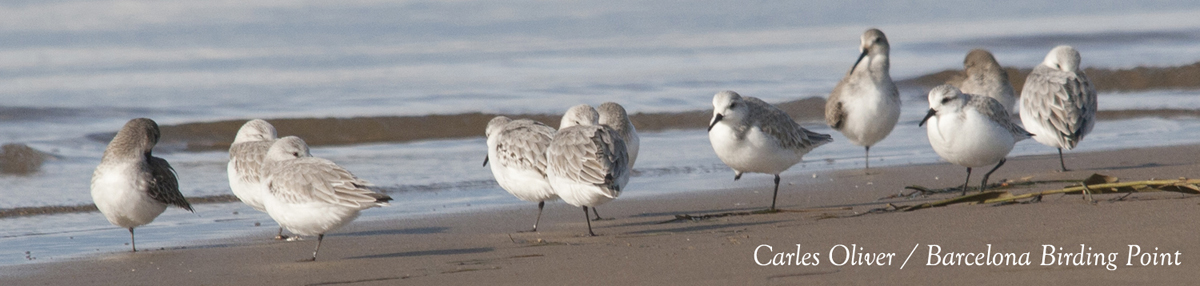
Sanderlings (Calidris alba) and Dunlins (Calidris alpina) are common winter visitors along Ebro Delta coastline.
After exploring some fresh water marshes we started to search for the species living in the salt plats and salt marshes. In La Tancada, one of the main salt plats in Ebro Delta, we found several Grey Plovers as well as some beautiful Slender-billed Gulls (Larus genei) feeding on the small salty lagoons along with Common Shelducks (Tadorna tadorna) and Greater Flamingos. Along the coast line we found several flocks of Dunlin (Calidris alpina) and Saderling (Calidris alba) along with some Kentish Plovers (Charadrius alexandrinus), Common Ringed Plovers (Charadrius hiaticula) and Little Stilts (Caladris minuta). At the same time we were checking the bay looking for sea ducks. Over fourteen Red-breasted Mergansers (Mergus merganser) were spotted in the bay along with numbers of Black-necked Grebes (Podiceps nigricollis). Among them one Slavonian Grebe (Podiceps auritus) was discovered, which was a really nice unexpected species as it is a really scarce winter bird in Catalonia (0-5 birds per winter). Some hundred meters ahead eight Common Scoters (Melanitta fusca) were sleeping in a big flock of Mallards, Teals, Red-crested Pochards and Northern Shovelers. Some meters beyond a gorgeous Black-throated Loon (Gavia arctica) was also fishing in the never-ending bay.
It was already half afternoon and a perfect moment to check for one of prime targets in the tour. The elusive and secretive Moustached Warbler (Acrocephalus melanopogon). We found it out in a gorgeous, two-minutes long sight, moving really low along the reedbed edge. Greater Bittern (Botaurus stellaris) was not appearing but a male Little Bittern (Ixobrychus minutus) made a nice flight over the lagoon with the sunset light.

This Osprey (Pandion haliaetos) was one of the last surprises during our time in Ebro Delta. It allowed some excellent images from all keen photographers in the group. Regarding to plastic rings was released in France.
Day 7. The final day started with some re-checking in the salty marshes to locate new species. Here we found several Dunlins and Sanderlings along with Turstone and one beautiful Osprey (Pandion haliaetos) with a morning fish as a prey.
Taking advantage that Ebro Delta is close to really interesting garrigas we took a walk over some slopes trying to locate the scarce Bonelli’s Eagle (Aquila fasciata). Although the large Eagle was not appearing we had some nice views of Sardinian Warbler, Goldcrest (Regulus regulus) and Eurasian Crag Martin (Ptynoprogne rupestris).
The last stop in our tour was in some small cliffs immediately South of Tarragona. This small cape gave us gorgeous views of Sardinian Warbler, Hoopoe, Mediterranean Gull (Larus melanocephalus), Northern Gannet (Sula bassana) and Arctic Skua (Stercorarius parasiticus) chasing a gull in the sunset light. Various flocks of Mediterranean Shearwaters (Puffinus mauretanicus) were also appearing as well as Shag (Phalacrocorax aristotelis) even when their view was not so spectacular as expected.
It was a great final spot for a incredible birding tour. We then went to drink a warm coffee. It was the end of an intense seven days birding, a great time that provided incredible sights and allow to all of us to know make new friendships!!!
The point is what surprises are waiting for us in 2013 edition?